Feather vs Teardrop vs Square Flags: Choosing the Right Shape for Your Site
Buyers usually pick a flag shape the way they pick a font — on how it looks in the catalogue. Then the flag goes up outside a shop on a windy high street and the choice gets renegotiated by physics. Shape is not decoration. It sets how much readable area you get per metre of pole, how much wind load the base has to hold, and whether the flag still looks like your brand on day 300. This guide walks through the three main shapes the way we spec them on the factory floor: feather, teardrop, and square or rectangle.
Updated 18 November 2026 · Reading time about 8 minutes · By the Dtent flag team
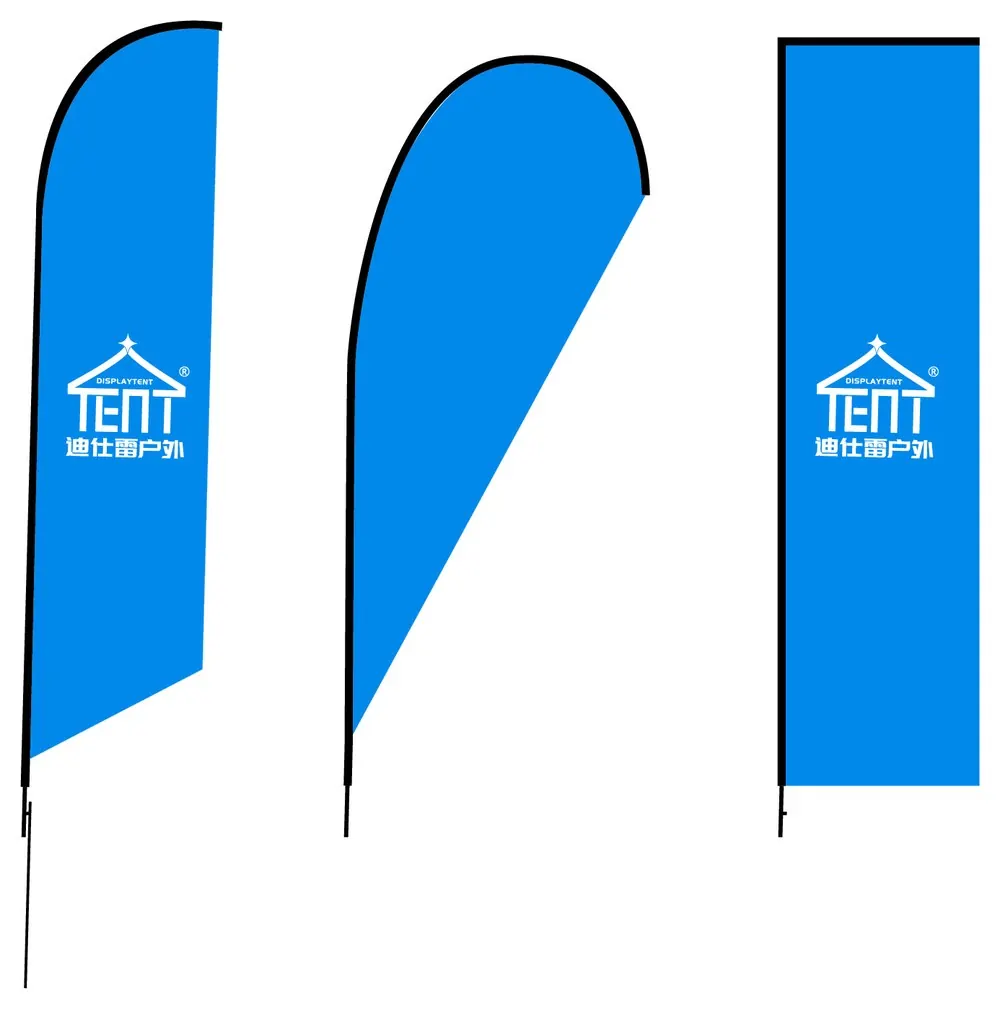
Three shapes, one production line
We print all of them the same way: dye-sublimation onto 110g knitted polyester, so the ink bonds into the fibre instead of sitting on top of it. Same fabric, same ink, same 2.7m–5.5m fibreglass pole family. What changes is the cut, and the cut is what decides everything downstream — readable area, wind behaviour, base requirement and how the flag is stored.
That is genuinely good news for buyers. You are not choosing between three products with different quality levels. You are choosing one product in three geometries, and the right answer depends almost entirely on where the flag will stand.
What each shape is actually for
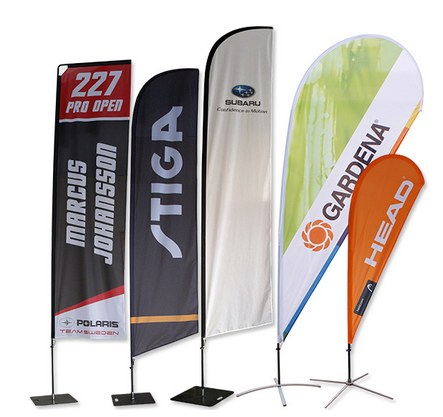
Strip away the marketing language and the three shapes map onto three jobs almost one to one.
| Feather | Maximum height and readable area on the smallest footprint. The default for pavement retail, car dealerships, showrooms, expo entrances and anything where the audience is moving past at speed. |
| Teardrop | More sail area low down, a softer silhouette, and a stronger look when left standing for months. The default for resorts, hospitality, golf clubs, show gardens and permanent forecourt branding. |
| Square / rectangle | A flat, billboard-like face that holds a logo grid, a price, a QR code or a menu. The default for indoor retail, exhibition halls, courtyards, real-estate boards and photo backdrops. |
Feather: the workhorse
The feather flag is the shape most of our repeat buyers order by the dozen, and the reason is purely geometric. The pole sits at the leading edge and the fabric curves back from it, so the whole flag height becomes graphic space with almost no width penalty. A 3.8m feather delivers a tall, thin block of colour that is legible from the side, from a distance, and through the gaps between parked cars — which is exactly the viewing condition on a real street.
It is also the shape that handles gusts best. The trailing edge is free, so air spills off it instead of loading a flat face. In practice that means a feather on a cross base with a water bag stays put in conditions where a square flag of the same area would be lying on the ground. Downsides, honestly: the tail can wrap around the pole in very light, swirling wind, and the narrow format punishes anyone who tries to fit five lines of copy. Keep feather artwork to a logo plus one line.
Teardrop: the shape you leave standing
Teardrop flags put their widest point high up and taper to a narrow base, which gives them a planted, deliberate silhouette — closer to signage than to promotion. That is why hotels, beach clubs and garden centres choose them: a teardrop can stand outside a property for a full season without looking like a clearance sale.
The trade-off is sail area up top. A teardrop of the same height as a feather carries noticeably more fabric in the wind, and because it is usually installed semi-permanently, it gets tested by weather the feather never sees. We therefore spec teardrops one base grade higher than the equivalent feather on the same site — steel plate or cross base with water bag on hard surfaces, spike plus guy line on grass. If you are weighing how much ballast a given site really needs, our anchoring and ballast guide covers the surface-by-surface math in more depth.
Square and rectangle: the flat face
Square flags are the odd one out, and they earn their place by being the only shape that gives you a true rectangle of printable area at eye level. That is what you need for a menu board outside a café, a QR code at a show entrance, a price block on a forecourt, or a 4-up logo grid at a distributor's stand.
The cost is wind. A flat face is a sail, and no amount of good printing changes that. Our guidance is simple: square flags belong in sheltered positions — courtyards, colonnades, indoor halls, against a building — or in the lower part of the height range on an exposed site with a heavy base. If a customer insists on a 4.5m square flag in an open car park, we will quote it, but we will also tell them a feather at the same height will stay upright more of the year.
Height math: how tall before it stops helping
Height is the single most over-ordered variable. Buyers assume taller is better; what taller actually does is extend the distance at which the logo is still readable — and if nobody is ever that far away, the extra metre is dead weight and extra sail area.
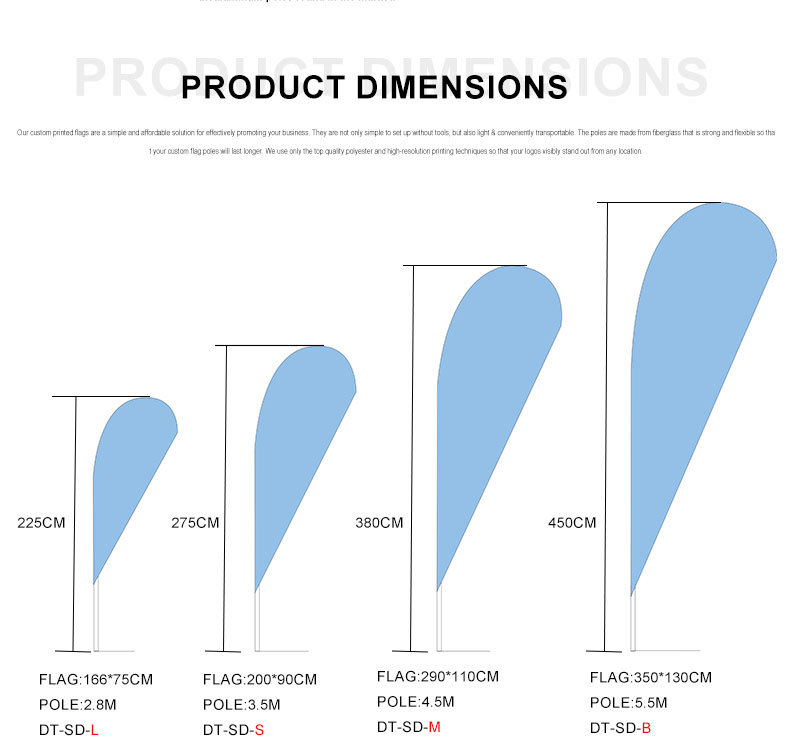
The rule we use when specing: a logo that fills roughly half the flag height reads comfortably at about 25 times its own height. Applied to our five standard heights, that gives a working range.
| 2.2 m | Comfortable at roughly 27 m. Pavement retail, doorway placement, indoor halls with a low ceiling. |
| 2.75 m / 2.8 m | Roughly 33–35 m. The default for a single shopfront or a single showroom bay. |
| 3.8 m | Roughly 47 m. Forecourts, car dealership line-ups, roadside retail where the audience is in vehicles. |
| 4.5 m | Roughly 55 m. Large forecourts, exhibition exteriors, anything read from across a multi-lane road. |
Two practical notes. First, do not mix heights in one row — a line of flags at 2.8m and 3.8m reads as an accident, not a system; pick one height per site and hold it. Second, remember that the bottom 40cm of any flag sits behind planters, bollards, parked cars and people. Put nothing important below knee height.
Base selection, by surface and by shape
This is where most overseas buyers get caught, because a flag quoted without the right base arrives unusable. Every base we ship is in the same family; the pairing is what matters.
| Grass / soil | Ground spike. Add the swivel joint so the flag can turn out of the wind instead of fighting it. |
| Concrete / paving | Steel plate or cross base, plus a water bag for anything above 2.8m or anything left out overnight. |
| Sand / beach | Long beach spike, or a drill base where the sand is soft and deep. Cross bases sink and tip. |
| Vehicles / forecourt | Car door base for drive-away placements, otherwise plate plus bag. |
| Building face | Wall bracket at an angle, no ground base at all — the cheapest way to add height to a narrow frontage. |
Our default packaging pairs each flag with a pole set and one base, and buyers who plan multi-site rollouts should keep that pairing fixed across sites so store staff are not improvising installation. The full base range, with photography, sits on the beach flags and banners product page.
Single-sided or double-sided, shape by shape
Single-sided prints mirror through to the back. For a logo, that is fine — a mirrored logo still reads as your logo, and it is what most retail buyers choose. Double-sided sews two printed layers with a light-blocking film between them, so text reads correctly from both directions.
Shape changes the calculation a little. A feather flag is usually viewed from one dominant direction — approaching traffic — so single-sided is genuinely adequate and saves money. A square or rectangle flag often stands at a junction or on a corner where it is read from both sides, and a mirrored back looks like a mistake on a flat billboard face; that is where double-sided pays for itself. Teardrops sit in between: pick double-sided if the flag marks an entrance people can approach from two sides.
Quantity math for a frontage
The most common brief we get is "how many do I need for my shop?" The answer scales with frontage, and one flag per 3–4 metres of street frontage is the number that keeps a row looking intentional rather than sparse. A 6m shopfront takes two; a 12m unit takes three to four, spaced evenly; a car forecourt is a different problem entirely and is usually laid out as a perimeter line every 8–10m so the flags frame the metal rather than hide it.
For anything beyond a single site, order spares. Flag fabric is durable but it is fabric — one unit in ten gets snagged, stolen or driven into. A 10% spare ratio costs very little on a 40-flag order and prevents a half-empty row three months later.
Artwork, colour and the file we need
Dye-sublimation on polyester does not hold colour the way paper does. Saturated blues and deep reds shift slightly, and a Pantone that looks perfect on screen can come back a touch warmer on fabric. We handle this with a printed colour reference on the same fabric before a production run — worth doing once per brand, then reused for every reorder.
Send vector artwork (AI, PDF or EPS) at 1:10 scale with fonts outlined, or a high-resolution PNG with transparency. Add 3–5mm bleed beyond the cut line and keep all text 40mm inside the seam. And keep the copy short: at 3.8m, a viewer at 40m resolves roughly a logo and four or five words. Anything more becomes texture.
Ordering, MOQ and lead time
Minimum order is one piece, and prices across the range sit between $15 and $35 per set FOB Dongguan depending on height, pole grade, base and print coverage — volume breaks start at 10 pieces. Single-shape flag orders run 7–12 working days in production. Mixed orders that combine flags with canopies, table covers or booth kit run 12–18 days, because the different product lines queue separately before final packing.
For a date-critical launch, plan backwards from the install date rather than the order date; our production lead time guide sets out the buffers, and the freight guide covers sea versus air for flag volumes, which are light but bulky and often ship better as LCL than buyers expect.
Next step
Tell us the site — surface, wind exposure, how far away the audience is, and how long the flag stays up. We will recommend a shape and height per position and pair each one with the right base, then send a proof and a written schedule. If you are building a full outdoor presence, flags pair naturally with a printed pop up canopy using the same colour profile, so the red on the flag and the red on the roof match in daylight.